
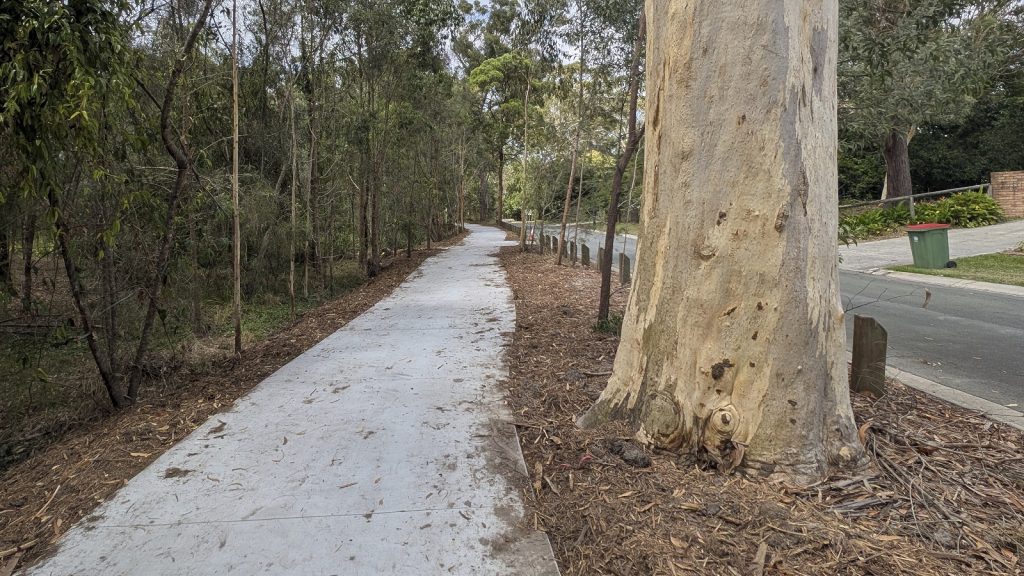
The 2.5-metre-wide concrete path constructed along Luke Street Thornlands, defies logic and common sense. Because a draftsperson drew a line on a map more than ten years ago, the route of the path was deemed non-negotiable. Apparently, no one involved in this early decision considered the consequences of the wide concrete path for the mature trees lining the street. Logical arguments, repeated correspondence to the Mayor, Councillors and Council Officers, and a well-supported public petition have all failed to alter this deeply flawed outcome.
The issue is the presence of a row of magnificent, old-growth trees, some with trunk diameters exceeding 100 centimetres. These koala food trees have somehow survived previous waves of development (and road building), only now to be placed in serious jeopardy by an unnecessary, wide concrete path. Despite this, the 2.5-metre path was forced through their root zones as if no alternative existed.


These trees already have their roots constrained by the sealed road on one side. The construction of this wide concrete path on the other side now covers the remaining root zone. This is not sustainable and places the trees under severe long-term stress, effectively condemning them to decline and eventual failure.
The Australian Standard AS4970:2025 Protection of Trees on Development Sites gives guidelines to be followed regarding the tree protection zone of trees: “TPZ (Tree Protection Zone) calculation (Diameter at Breast Height (DBH) x 12). This area is considered essential for the tree’s physiological processes, including the uptake of water and nutrients to sustain its health.”
For trees with a DBH of one metre, as is the case here, a Tree Protection Zone of 12 metres is required. However, here we find in the worst cases, the path is barely 30 centimetres from the trunk. Why were the Australian Standard Guidelines ignored by Council Planning?
These trees are all important koala food trees and have been regularly used by koalas. No evidence of usage has been found since the building of the path.
The irrationality of the chosen route was clearly demonstrated to Council using maps showing that the most direct and logical access route runs from Marcoola Street, not Luke Street. Marcoola Street is where the majority of path users come from, while Luke Street is a cul-de-sac with very few residences.
As shown below, the path from Marcoola Street has already been constructed. This path, approximately 1.5 metres wide, has ample space to be widened safely without endangering very old trees. This alternative would have met the need for a multi-purpose trail while preserving significant vegetation.


Council was formally advised of the risks posed to the trees. In response it was claimed that advice had been provided by the Environmental Management Team regarding root protection. Despite assurances, this promised information was never supplied. A site meeting was arranged and then cancelled by the responsible officer, and subsequent requests for an alternative meeting were ignored.
The local Councillor was also made aware of these concerns but chose not to engage with the facts presented, instead criticising the writer personally.
Some of the veteran trees already have compromised branches that are likely to fall, as shown in the photographs below. This is likely to pose an ongoing safety risk to path users.


A more considered, collaborative approach by Council could have prevented this situation entirely. At this point, all that can be done is to monitor the trees and hope they survive.
Lynn Roberts BSc (AES)
President – Eprapah Creek Catchment Landcare Association Inc.
In August 2025 Redlands2030 published Protect trees at Luke Street Thornlands by Lynn Roberts